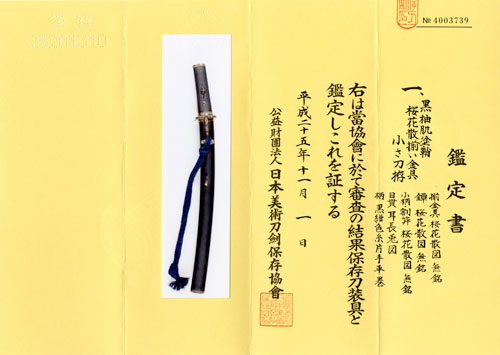
with) Black yuzu fruit surface finish lacquered scabbard Sakura flowers design Chisa-katana Koshirae
(Hozon Token)

(Tokubetsu Kicho Token)

(Hozon Tousougu)
Length of cutting edge 32.9cm Curvature 0.5cm Width of base 26.1mm Thickness of base 5.0mm
Forging pattern (kitae hada) : Kitae hada is Itame hada mixing with small Mokume-hada partially and flowing Masame-hada ware appears mostly along hardening boundary line. The surface is covered in Ji-nie of hard metal granules over the surface with swirl Chikei darkish Nie lines activity.
Tempering pattern (hamon) : Quenching area on base is covered with a bit on tight side Nioi, narrow and small gunomemidare. Upper the blade, rather on stronger side Nie of hard metal granules appears. Hamon appears to be taller and larger gunome of which head is round with narrow in the middle or slanting indication. The interior of temper is filled with deep mist granules of Nioi and works with thick feet of Ashi and short lines of Nie so called Sunagashi. Back ridge of Mune appears hardening temper Muneyaki down to Mune-machi.
Temper of tip (boshi) : Temper of tip is rather on stronger side of hardening Nie, forms irregular pattern of Jizo-profile shape with Hakikake brush up indication then turns back deeply that connects to Muneyaki on back ridge.
Tang (Nakago) : Nakago is UBU original slightly curved. Higaki of check filemarks. Double-bevelled Kurijiri heel shape. Two retaining holes of Mekugiana (one is filled). There is small three character of inscription that reads Kanetomo-saku 兼知作.
KANETOMO 兼知 reportedly lived in Seki district in the late Muromachi period of Eisho era (1504-20), a son of KANEHISA 兼久, belonged to Tokuin lineage 得印派 among 7 major group of Shichi-to-sei 七頭制.
During the battle age in the late Muromachi period, sword makers set up systematized production group of Shichi-to-sei 七頭制 to meet with sharp rise in demand for the battle ages. Each leader of 7 groups Shichi-to-sei 七頭制 (note) played a major role of collecting orders, value control, purchasing raw materials of steels or charcoal and quality control.
On after the deregulation policy of Rakuichi-Rakuza 楽市楽座 adopted by Oda Nobunaga 織田信長, Shichi-to-sei 七頭制 system had ruined and then most of sword makers in Seki district scattered away to the major castle towns to find new fields of activity. This movement of sword makers in Seki had a great influence on the sword making to the continued Shinto age.
Black yuzu fruit surface finish lacquered scabbard Sakura flowers design Chisa-katana Koshirae consists of : (click HERE for entire Koshirae mount / HERE for each fitting)
All metal fitting of Sakura flowers design : Fuchi/Kashira, Koikuchi, Kurikata, Kaeri-tsuno, Kojiri, Kozuka and Kougai - made of iron, gold Numome-style inlay
Menuki : Rabbit of long ear design, Shakudo, Yobori
Tsuka : Black Koto-ito string wrapp
Scabbard : yuzu of circus fruit surface finish, Kozuka and Kogai slot-pockets, Sakura-flowers design of Koikuchi, Kurikata, Kaeri-tsuno and Kojiri end
This Koshirae is also awarded with NBTHK(Hozon Tousougu)
Silver habaki collar, preserved in a Shira-saya plain wood mounting
Good old polish/Condition scale: very good (using a scale of mint-excellent-very good-good-fair-poor)
(note) Shichi-to-sei 七頭制 is composed of Zenjo 善定, San'ami 三阿弥, Nara, 奈良, Tokuin 得印, Tokunaga 得永, Ryoken 良賢, Muroya 室屋
reference data :
Suzuki Takuo/Sugiura Yoshiyuki,Muromachi-ki Mino-toko-no Kenkyu, Ribun-shuppan, 2006
Honma Kunzan/Ishii Masakuni, Nihon-to Meikan, Yuzankaku, 1975