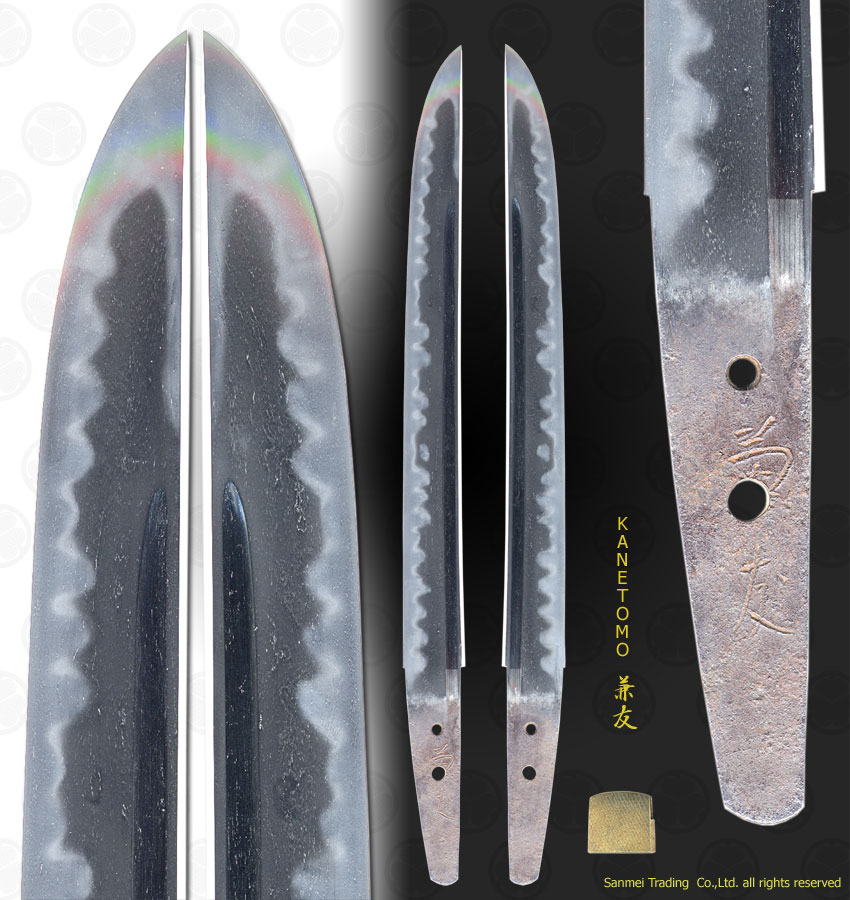
Length of cutting edge26.3cm Curvature0.1cm Width of base26.3mm Thickness of base5.3mm
Forging(Hada) : Hada is Itame mixing in with flowing Masame. There is Shirake-Utsuri reflection.
Temper(Hamon) : Hamon is Nioi-based Gunome midare. Habuchi is covered in Ko-nie.
Temper of tip(Boshi) : Temper of Boshi creates JIZOU-shape, small circle deeply turns back.
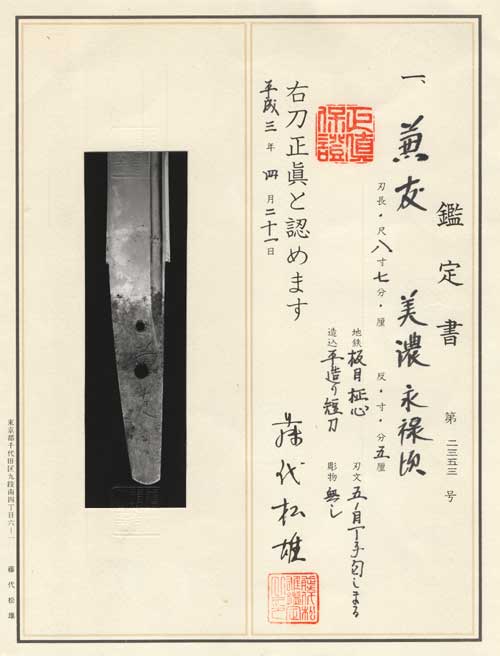
Tang(Nakago) : Nakago is UBU original. The shape of bottom is KURIJIRI. There is two ANA. The signature of Hakiomote is two large character that reads KANE-TOMO.
There are seven sword smiths named KANETOMO identified, two in Naoe-Shizu and five in Seki. The first smith Kanetomo was a pupil of Shizu Saburo Kaneuji during Enbun period in Nanbokucho. The future generations of KANETOMO in Ouei period had moved to Seki town and joined SANAMI school. This is the Tanto made by Kanetomo during Eiroku period(middle of 16th century). Jigane is Itame-hada with flowing Masame and has Utsuri refrection in hiraji surface. Boshi shows a typical JIZOU-shape. Entire Ji-ha is fine condition and Furura is in full. One of KANETOMO families had moved to Kiyosu in Owari and learned from Umetada Myouju then enjoyed HIGONO-KAMI title. He had moved to AKI-province(Hiroshima) along with a federal load FUKUSHIMA MASANORI . He changed his name to TERUHIRO.
Gold foil Habaki collar. Shira-Saya mounting.