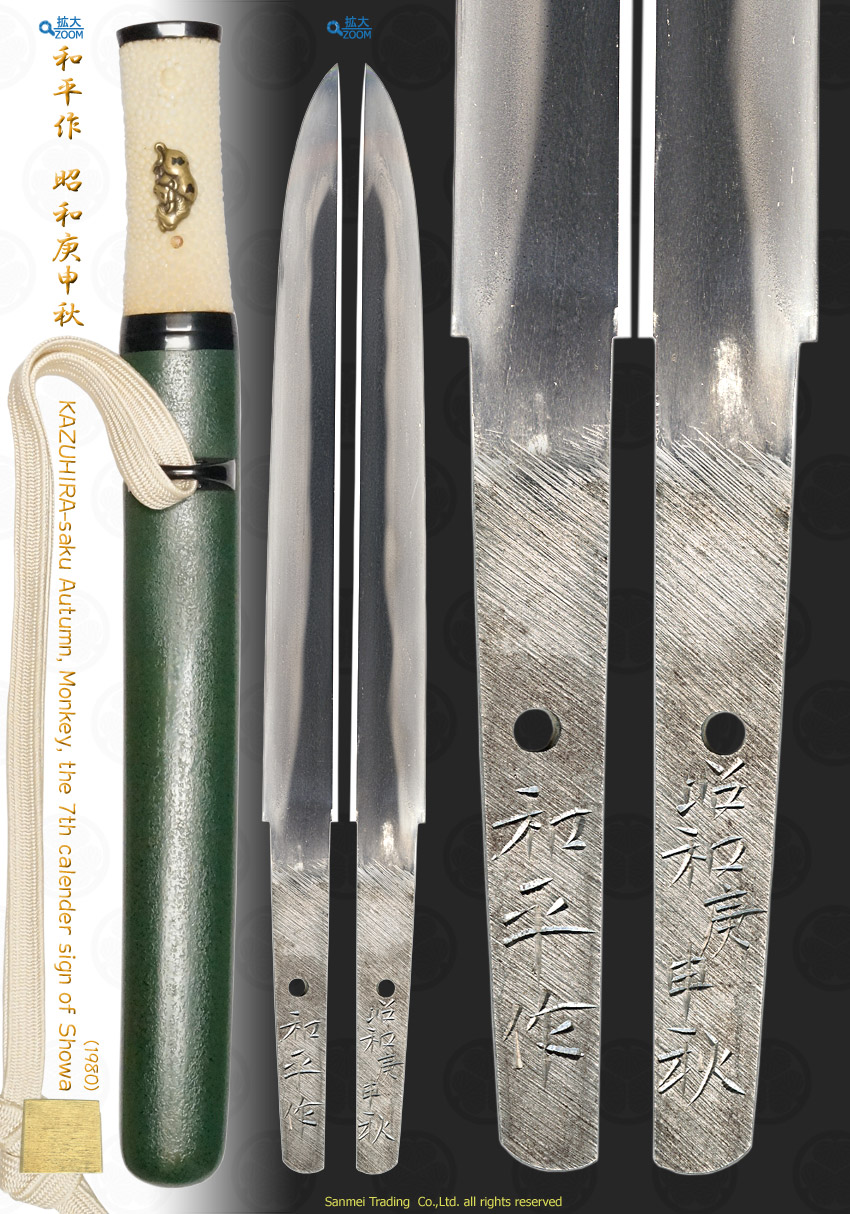
Autumn, Monkey, the 7th calendar sign of Showa
with) Yellowish green scabbard Aikuchi style Tanto fitting
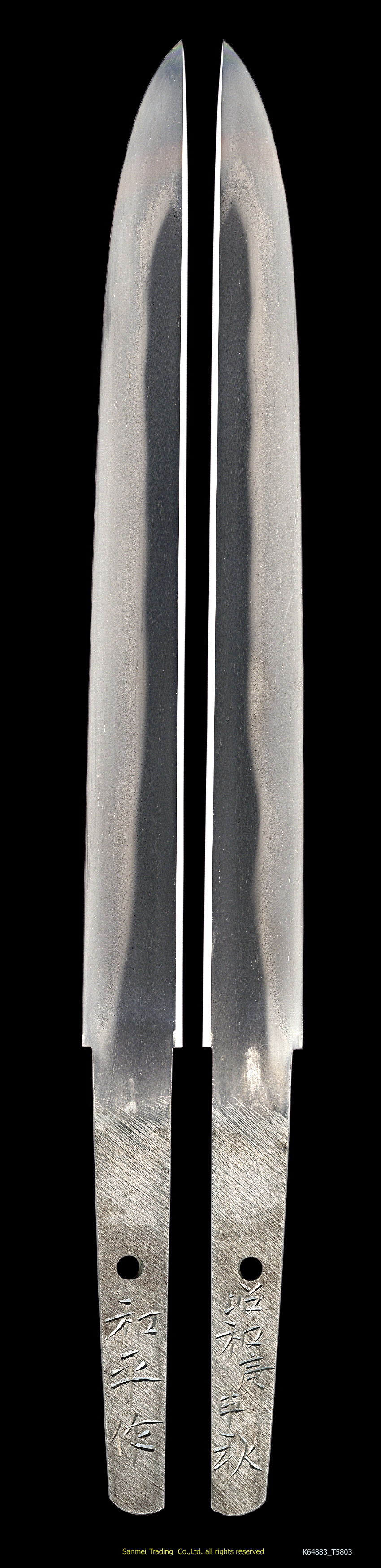
Length of cutting edge 18.9cm a bit inward curve Width of base 19.0mm Thickness of base 6.5mm
Forging (Hada) : Forging forms generous Itame-hada which is outstandingly visible against sparkling glitter so called Ji-Nie crystallized mist and darkish thick Nie lines so called Chikei activity is lively realized over the surface.
Temper line (Hamon) : Hamon is gentle wavy "Notare" with powerful side Nie-based sparkling hard metal granules, in which interior is filled with deep Nioi-mist. Upper the blade, further, stronger and thicker the Nie where frequent thick lines of Nie and short lines of Nie (Kinsuji and Sunagashi) grows increasingly active.
Temper of tip (Boshi) : Quenching temper of upper Boshi becomes more active with intensive Nie lines of "Hakikake" activity with small circle turns back shortly.
Tang (Nakago) : Nakago is UBU, unaltered. greatly slanting left (O-sujikai) file marks. The Ha-agari kurijiri (single-bevelled) heel. One peg hole. The signature in front is KAZUHIRA-saku 和平作 and the date of year Autumn, Monkey, the 7th calender sign of Showa (1980) 昭和庚申秋 is chiseled on the other side.
Smith Ōkubo KAZUHIRA 大久保 和平 was born in December 15, 1943 in Fujisawa city, Kanagawa pref. He joined to the school of a Living National Treasure the late Miyairi Yukihira 宮入行平 (1913-77) in 1961 when he was 18 years old. After five years of fade into obscurity under the school of Miyairi, he became independent in 1966 and set up his own studio.
He continuously had won numerous prizes starting from 1966 in the contemporary Japanese Sword Fine arts Contests held by the Japanese Swords Preservation Society such as "Doryoku Award" 7 times, "Shourei Award" 2 times, "Yushu Award" 2 times, "Kunzan Award" once and finally he became qualified for an exemption of examination when displaying art works at the Japanese swords fine arts contest exhibition so called "MUKANSA" prize in 2000 when he was 57 years old but thought he was talented, regretfully he died young two years later at the age of 59 years old in 2002.
The subject Tanto was made in 1980 when he was matured at 36 years old. He would bear the work of noble tantos that belongs to pure Soshu school in his mind and it's workmanship has close resemblance to the work of SA-monji 左文字 or NORISHIGE 則重 from Kamakura period.
This tanto comes with Yellowish green lacquered scabbard Aikuchi style Tanto fitting that consists of :
- White rayskin wrapped hilt
- Fuchi,Kashira,Koikuchi,Kurikata : black water buffalo horn
- Menuki : Rice harvest design. Yobori curving gold Iroe inlay
An good original polish/Condition scale: mint (using a scale of mint-excellent-very good-good-fair-poor).