with) Black lacquered scabbard/shaft
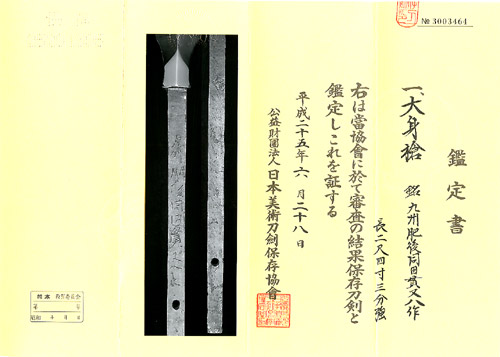
Length of cutting edge 73.8cm Length of tang 83.5cm Width of base 33.1mm Thickness of neck 18.5mm
Forging(Hada): Itame mixing with entwined flowing Masame ware. Upper the spear sparkling Ji-nie glitter covers thickly. There is a g grain loosen opening ware that runs vertically upper the Hiraji-surface.
Temper(Hamon): Hamon starts Nioi based with straight with slight wave indication, middle becomes strogner the Nie sparklings, Gunome and Clove outlline and upper the spear, the strongest coarse Nie granules attaches to form Hitatsura scene where temper spills over Hiraji. In the interior of temper, thick Nie-ashi feet appears and thick lines of Nie "Kinsen" and short lines of Nie "Sunagashi" work across the feet. The temper scene of tip shows rich Nie broad-minded activity.
Temper of tip(Boshi): Boshi forms irregular pattern with small circle turns back deeply.
Tang(Nakago): Nakago is in UBU original. Two peg holes. Kiri (horizontal) filemarks above the first hole and below forms Sujikai (slanting left) to Osujikai (greatly slanting left) gradually. The signature in front is ten large character that reads Kyushu Higo Doutanuki MATAHACHI-saku 九州肥後同田貫又八作.
Kumamoto, Higo domain used to be prosperous as traditional steel manufacturing using foot bellows since the Middle Ages. In the end of Kamakura 14th century, a founder of Enju 延寿 school - Rai KUKNIMURA 来国村 had been invited from Yamashiro, Kyoto to provide against Mongol invasions of Japan. However during Nanbokucho period as powerful clan Kikuchi 菊池 declined in power, sword makers in Enju school had disapperaed or scattered away.
Sword makers in Doutanuki 同田貫 school were the descendants of Enju 延寿 who were invited by the famed feudal lord Kato Kiyomasa 加藤清正. He came to Kumamoto in Tensho 16 (1588) and equipperd Kumamoto Castle with armed swords, spears and Naginatas made by Doutanuki school . Their swords, spears and Naginatas have been highly appreised as "the most supreme sharp and durable" and had been used for such as Japanese invasions of Korea (1592–98), Battle of Sekigahara or Siege of Osaka. Therefore many of exsisting works by Doutanuki have worn down due to the usage and repeated polish. However some katanas or spears with long inscriptions with additional name such as KIYOKUNI 清国, MASAKUNI 正国, HEIBU 兵部, EMON 右衛門, MATAHACHI 又八 were custom order made exclusively for a higher rank commander of Samurai army and those were mostly elaborately superior made that hold higher artistic value but on the other hand most of shorter Wakizashi which were equipped in Kumamoto Castle had no inscriptions but marked only a consecutive number.
The most singificantly, perhaps, the subject spear holds the majestic original shape even it's tang since the Warnig States period. Although it is an old polish status, there are some scratches here and there, flamboyant hamon is vividly sparkling and remains very good condition.This would be an evidence that this spear have been highly treasured as a brilliant military feat.
Preserved in an old scabbard (black lacquer worn out due to age) and copper work black lacquered shaft.
An old polish/Condition scale: very good (using a scale of mint-excellent-very good-good-fair-poor)
reference : Numata Kanetsugu, Shinpan Nihon-no-Meisou, Yuzankaku, 1974