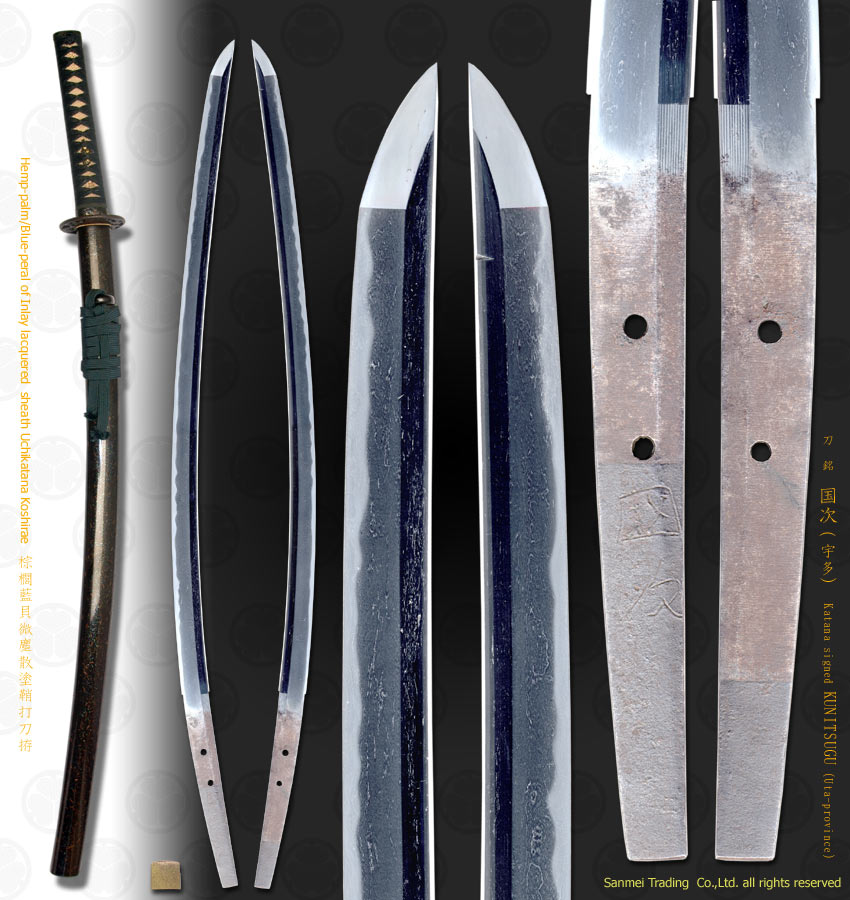
with)Hemp-Palm/Blue-Pearl of inlay lacquered sheath Uchikatana Koshirae
Length of cutting edge68.8cm Curvature2.3cm Width of base28.8mm Thickness of base7.1mm Width of Yokote20.1mm
Kitae(forging pattern) : Kitae-hada is outstanding itame mixing in with ranging large mokume hada (burl-grained) in upper area. The entire steel is clear dark bluish.
Hamon(tempering pattern) : Hamon is small gunome and choji-ha clove outline, deep nioi-mist and bright nie attaches along the temper line. There is rich activity in the interior of temper such as choji-feet, kinsen and Sunagashi. The Ji-ha of this katana is clearly bright and vivid.
Boshi (tip): The temper of the tip in hakiomome is shallow wavy and hakikake (brushing end) and ura is shallow wavy with yakizume end (there is no turn back).
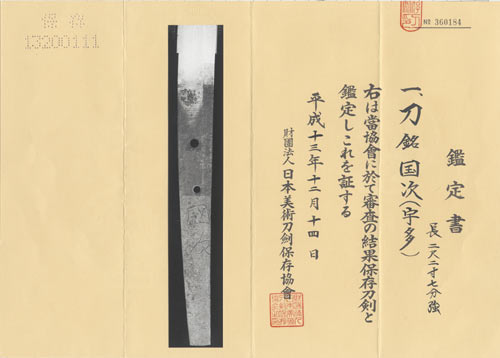
Nakago(tang) : Suriage cut, kiri horizontal filemarks. Two mekugi-ana. The signature in hakiomote is chiselled large two character - KUNI TSUGU.
UTA school in Echu province were founded in the frontier KUNIMITSU during end of Kamakura period (14th century) in Uta-gun Yamato province. His son-KUNIFUSA had learned from Norishige who is celebrated as a pupil of famed smith Masamune. Most of signed articles by Uta-school have been recognized on after early Muromachi period (15th century). This heroic katana is certainly a work of 1st generation KUNITSUGU who is a son of KUNIFUSA, may possibly be one of the good examples among long katanas with genuine signature by KUNITSUGU, in the earlier period of Uta-school. This katana is although slightly suriage -cut and became short by about two-sun, still stands with funbari almost an original shape when it was made. The workmanship shows a strong yamato favor. In the mune, there are three-four places marked with powerful sword cuts that attest to the distinguished ware record of this blade. This katana is recent and elaborate polish and new shira-saya has been made. There are some places of forging opening marks - in the omote, about 65mm above the hamachi (beginning of temper) in the interior of temper, there is a flowing grain opening mark in about 13mm long and a bit upper hiraji area, there is grain opening mark in about 7mm long. In the ura side at the beginning of temper (hamachi), there is an entwined opening mark. These wares are possibly eliminated and appears along with forging marks that doesn't outstand and can recognized as normal common wares in consideration of the age in almost 600 years. A relatively large number of KUNITSUGU's tanto have been handed down however katanas are rare. The workmanship is extravagant and hidden an awe-inspiring power.
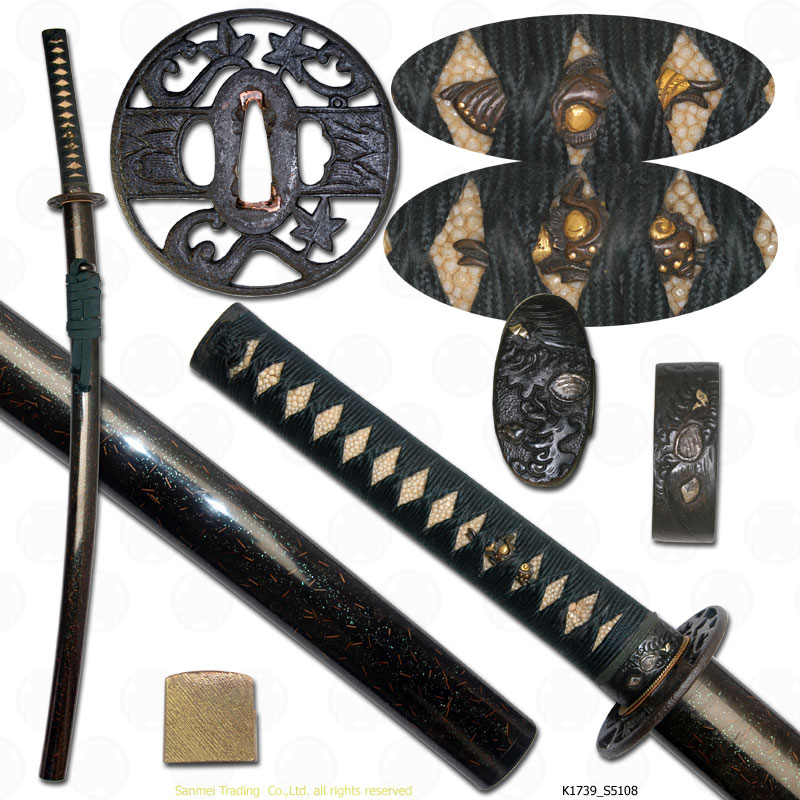
Hemp-Palm/Blue-Pearl of inlay lacquered sheath Uchikatana Koshirae set of mounts comprising : Shakudo maple leaf motif open-work tsuba. all ,material of the koshirae is mint condition in good old atmosphere. Gold plated copper habaki collar. Shira-Saya plain wood mounting.