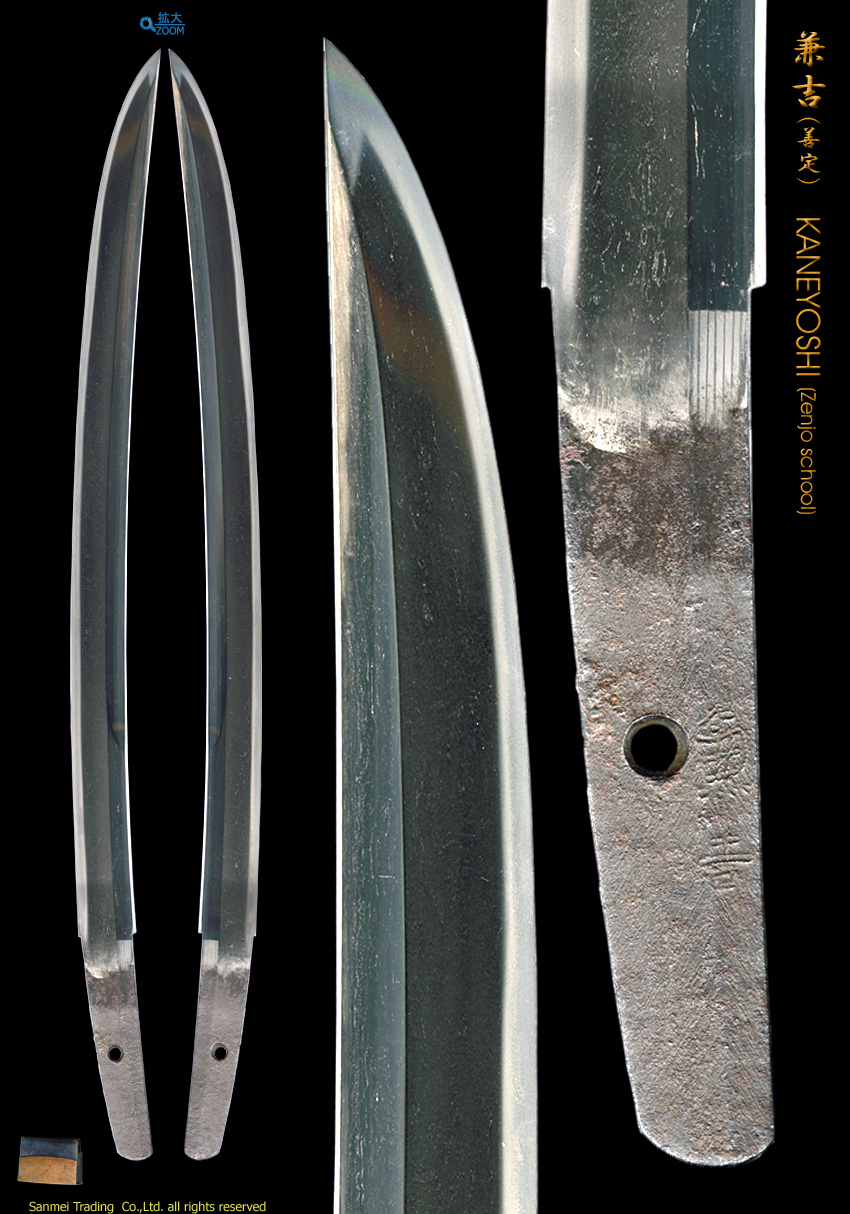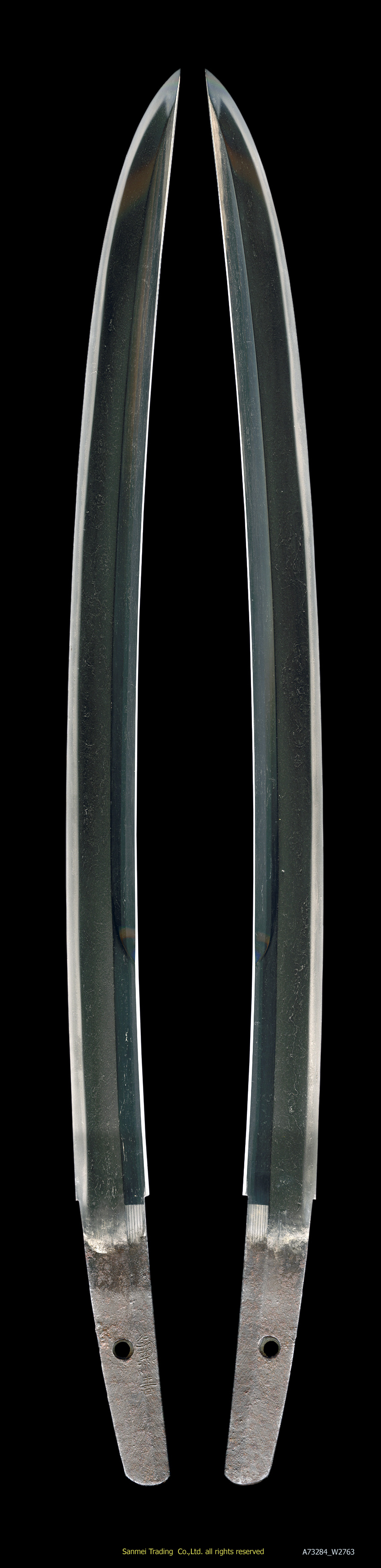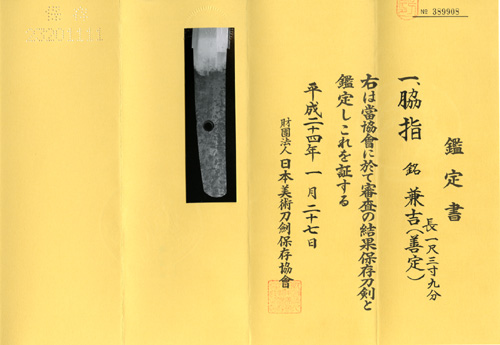
Length of cutting edge42.0cm Curvature1.0cm Width of base27.4mm Thickness of Shinogi ridge7.0mm Thickness of base6.0mm
Forging pattern (kitae hada) : Kitae hada is well kneaded Itame mixing with Mokume hada which is softly moistened springs out from fine steel.
Tempering pattern (hamon) : Hamon is medium-straight Suguha mixing with small irregular pattern of Ashi, Hotsure and Uchinoke indication of which temper edge is solidly tight with bright ko-nie granules.
Temper of tip (boshi) : Temper of Boshi is straight sharpened up with small circle deeply turns back connecting to Muneyaki back temper.
Tang (Nakago) : Nakago is UBU original with Ha-agari Kurijiri fully round heel shape. One original Mekugi-ana peg hole. V-shape(Takanoha) file marks. Back ridge is well-rounded contours. The signature in front is located next to peg hole on the shinogi-ji, two small characters that reads KANE YOSHI 兼吉.
The first smith KANEYOSHI(兼吉) in Mino province had came from Tegai school in Yamato domain to Mino province in end 14th - early 15th century.
He played the first chief of Zenjo school among Seven Seki major schools. His works with the date of year ranges the earliest Nanbokucho from Kouou 1, (1389) to the Ouei - Eikyo (1429-1440) era, early Muromachi period. His initial smith name was KANEYOSHI(包吉) while he was in Tegai town in Yamato province and his given name was Seijirou 清治郎.
This long Unokubi-zukuri wakizashi - supplement usage for long tachi showing a typical style of early Muromachi period - gracefully decent waist point curve on base adding upper pointed curve which shows a good example during Ouei - Eikyo era in peaceful period and typical Yamato school favor can be seen.
As the frontier of Zenjo-school, his works have been highly regarded and descended to Kanemoto, Kanefusa, Ujifusa and Kanemichi who was a father of Iganokami Kinmichi, Tanbanokami Yoshimichi and Echunokami Masatoshi, all of them played major roles of sword history.
Old polish/Condition scale: very good (using a scale of mint-excellent-very good-good-fair-poor) condition.
Preserved in a Shira-Saya plain wood mounting. Shakudo/Suaka copper double layer Habaki collar.
reference data:
Suzuki Takuo/Sugiura Yoshiyuki Muromachiki Mino Toko no Kenkyu 2007
Honma Kunzan/Ishii Masakuni Nihonto Meikan Yuzankaku 1975