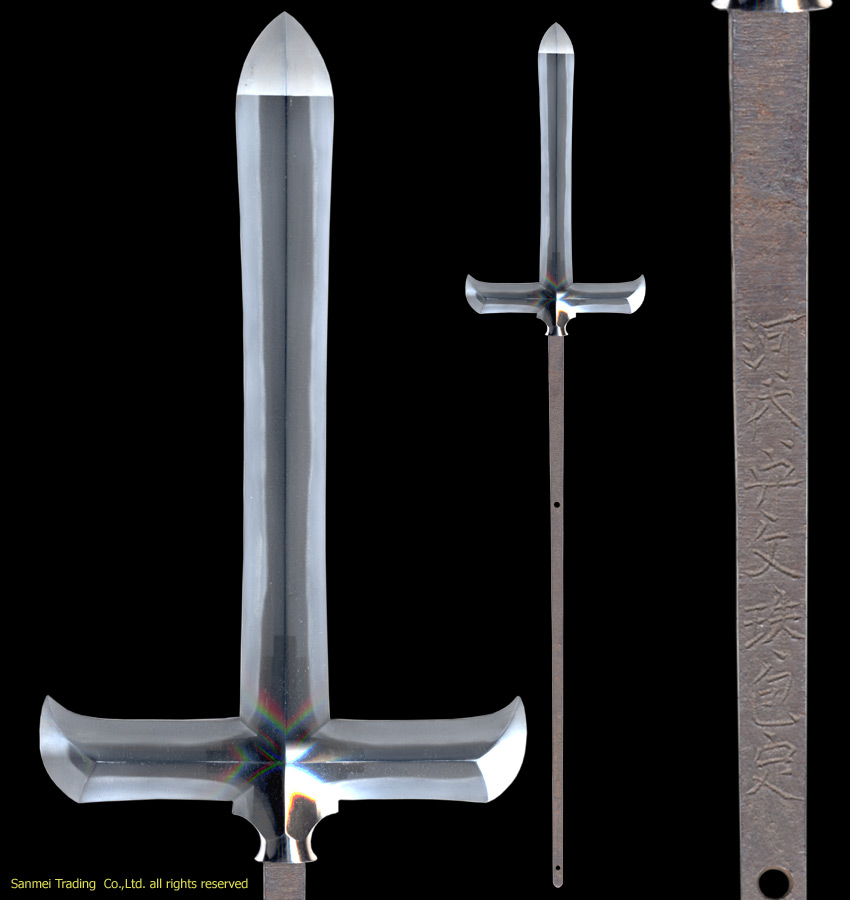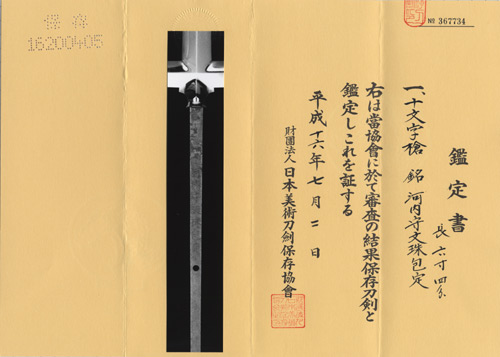
Length of cutting edge20.6cm Width12.0cm Length of Nakago36.6cm Thickness of tip7.7mm
Kitae(forging pattern) : Combination of fine masame and tight ko-itame grain marks. Jigane is covered in ji-nie hard metal granules over the surface of blade.
Hamon(tempering pattern) : Hamon is straight(sugu) mixing in with combination of Hotsure and Ni-juha, Bright nie and deep nioi-kuchi incorporating Yubashiri into the hiraji surface.
Nakago(tang) : Ubu(unaltered) with Kiri horizontal file marks and lower is O-Sujikai file marks, two original mekugi-ana(retaining hole), Kurijiri(rounded heel) signed large character that reads Kawachi no kami Monju kanesada.
The width of the tip in full and thick kasane. Here is quite massive Ju-monji-Yari during 17th century. The smith Monju KANESADA was born in Yamato province and worked in Kyoto and Edo. His real name is Monju Matasaburou, a descendant of Tegai Kanenaga. Generally it is quite difficult to make such shape and is also hard to forge, therefore many of Jumon-ji Yari shows some loose grain marks or opening wares or imperfect tempering.
However unlike those yari that usually seen, this Jumonji-yari uses very fine steel material, elaborately forged and fine tempering. Jigane is ko-itame based and clear masame-hada and tempering edge is covered in thick and uniform nie whcih is vivid and bright. This is a fine example of healthy Ju-moni yari and shows a typical character of yamato school.
Comes in old plain wood mounting.